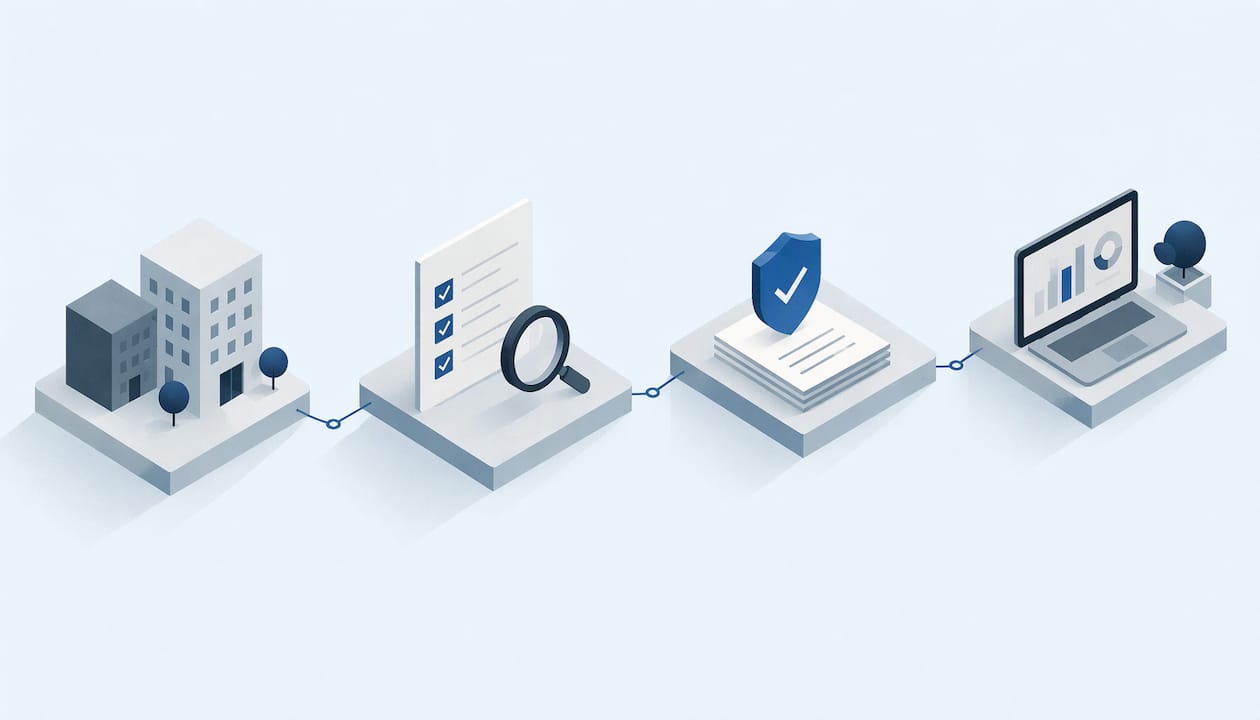
Third-party risk management (TPRM) is how you find, assess, contract with, monitor and exit the vendors that touch your data, systems or operations. For an owner-led business, it comes down to a few habits: know which vendors matter, check their security before you hand over access, put responsibilities in writing, and keep watching after the contract is signed. This guide walks through each step with the guidance U.S. regulators and standards bodies publish.
TL;DR
- TPRM covers the whole vendor relationship: selection, contracting, ongoing oversight and termination.
- Outsourcing a function does not outsource the responsibility. Owners and executives still answer for the risk.
- Check a vendor before granting access: what data it will touch, its security history, its controls and independent audit reports.
- Write a shared responsibility model into the agreement so nobody assumes someone else patches, backs up or trains.
- Review vendors on a schedule and after any incident or major change, not only at renewal.
Table of Contents
- What third-party risk management is and why it matters
- The lifecycle: the phases of a TPRM program
- Start with an inventory and tiers
- How to assess a vendor’s security before you share data
- What the contract should say
- The risks to weigh with IT vendors
- Ongoing oversight: monitoring, reviews and incidents
- Third-party risk management vs. GRC
- Frameworks you can borrow
- How we can help
- FAQ
- Sources
What third-party risk management is and why it matters
Every business runs on vendors: the IT provider, the cloud platform, the payroll processor, the software that holds customer records. Each one is a door into your environment. Third-party risk management is the discipline of deciding which doors to open, how wide, and how you will know if one is left unlocked.
The New York Department of Financial Services frames it as managing cybersecurity risks tied to third-party service providers across the relationship lifecycle: due diligence and selection, contracting, ongoing oversight and termination. That framing is aimed at financial firms, but the logic fits any company that shares sensitive data.
One point deserves emphasis. CISA’s guidance for customers of managed service providers notes that outsourcing does not absolve executives of risk management responsibilities. If a vendor is breached through your access, customers, insurers and regulators will still look at you first.
The lifecycle: the phases of a TPRM program
You will see the phases described a few ways. They all trace the same arc.
NERC describes a vendor lifecycle with four stages: identification, procurement, installation and use (including support and patching), and termination. NERC adds that risks should be addressed at each stage and documented in a supply chain risk management plan.
NIST takes a different cut. Its supply chain guidance, SP 800-161, describes a continuous process of framing, assessing, responding to and monitoring risk, built into enterprise risk management.
For a small or midsize business, a workable version looks like this:
| Phase | What you do | Output |
|---|---|---|
| Identify | List every vendor with access to data, systems or facilities, and rank them by how much damage a failure would cause | Vendor inventory with risk tiers |
| Assess | Review the vendor’s security before you sign | Due diligence file |
| Contract | Set security standards, reporting duties and audit rights | Signed agreement and responsibility model |
| Monitor | Re-check on a schedule and after changes or incidents | Review notes, updated tier |
| Exit | Revoke access, retrieve or delete data, close accounts | Offboarding checklist |
The FFIEC adds a governance point: an effective program gives management a framework to identify, measure, mitigate, monitor and report risks from third-party providers, and it is governed across the enterprise, not left to the technology team alone. In an owner-led company, that means the owner or a named executive signs off on the vendor list.
Start with an inventory and tiers
You cannot manage vendors you have not listed. Pull names from accounts payable, single sign-on, your Microsoft 365 or Google admin console, and your IT provider’s documentation. Include the vendors people signed up for with a company card.
Then tier them with two questions:
- What data or systems can this vendor reach?
- What happens to the business if this vendor is down for a week, or breached?
A cleaning company with a door code and a managed IT provider with administrator rights to every laptop are not the same risk. Spend your effort on the top tier first.
How to assess a vendor’s security before you share data
A vendor security assessment does not need to be a 300-question spreadsheet. It needs to answer a handful of questions well. NYDFS lists the due diligence factors that matter most: the type and extent of access to your systems and nonpublic information, the provider’s reputation including cybersecurity history and financial stability, whether it runs a cybersecurity program, and how it controls, handles and stores your data, including segmentation and encryption based on data sensitivity.
Turn that into a practical checklist:
- Access. What exactly will the vendor touch? Which accounts, which systems, how privileged?
- Data handling. Where is your data stored, who can see it, is it encrypted at rest and in transit, and what happens to it when you leave?
- Track record. Has the vendor had a security event? How did it respond and communicate?
- Financial health. CISA points out that risks to the vendor itself, including financial health, can signal future service disruptions.
- Independent proof. Ask for third-party attestations. NERC suggests considering a vendor’s certification to recognized standards such as ISO 27001 or SOC 2 where available. The FFIEC likewise expects management to obtain independent review of a provider’s security through audit and test reports.
Match the depth to the tier. A low-tier vendor may need a short questionnaire. A vendor with administrator access deserves the full review, a report you actually read, and a conversation with the person who will run your account.
What the contract should say
Due diligence means little if the contract is silent. The FFIEC says agreements should include minimum control and reporting standards, the right to require changes as environments change, and access for you or an independent auditor to evaluate performance.

CISA adds a tool that works well for small companies: a Shared Responsibility Model that lists what the vendor does, what you do, and what you do together. It settles questions that otherwise surface during an incident: who applies patches, who maintains hardware, who trains employees.
Also put in writing:
- How fast the vendor must notify you of a security event
- Who holds your data and in what format you get it back at exit
- Which subcontractors the vendor may use
- What your cyber insurance carrier expects from your vendors
That last item matters more each renewal cycle. If you want help lining up vendor controls with insurer requirements, our cybersecurity compliance guide explains what compliance services typically cover.
The risks to weigh with IT vendors
CISA tells executives to understand a specific set of consequences: loss of core systems and services, loss of data confidentiality, integrity or availability, operational disruption, loss of customer and market confidence, and fines, legal fees and regulatory costs. Use that list as a scoring prompt when you tier vendors.
The weight of each depends on your business. A retailer selling online has a different exposure from a professional services firm. If you sell online, this overview of cybersecurity for e-commerce businesses shows why the platforms and plugins behind a storefront deserve the same scrutiny as your own network.
CISA also frames the decision to outsource as a balance: executives weigh cost and efficiency against reliability and security. Cheaper is a legitimate factor, but it belongs in the same conversation as the questions above.
Ongoing oversight: monitoring, reviews and incidents
The most common failure is treating the vendor review as a one-time event at signing. NYDFS advises ongoing monitoring and oversight informed by the evolving threat and regulatory landscape and by whether the provider has experienced a cybersecurity event, with periodic, risk-based assessments through the relationship. NIST describes monitoring as ongoing tracking of changes with a feedback loop for continuous improvement.
A simple rhythm:
- Top tier vendors: review at least annually, plus whenever they change ownership, hosting, subcontractors or scope.
- Mid tier: review at renewal and when their attestation reports are reissued.
- All vendors: remove access promptly when a project ends or a person leaves.
Report upward, too. NACD’s director guidance says cyber-risk reporting should happen at least quarterly and immediately after any material incident or significant change in risk exposure. The same handbook says incident response should include coordinated notification of third parties such as cloud providers, vendors or integrators, and that incident reports should cover the affected systems, containment actions, communications and regulatory notifications, recovery timelines and lessons learned. Even without a board, an owner can ask for that same one-page summary.
The FFIEC expects a board to hold senior management responsible for appropriate oversight of third-party relationships. In a smaller company, that senior manager is you, or someone you name.
Third-party risk management vs. GRC
GRC stands for governance, risk and compliance. It is the umbrella: how a company sets policy, manages risk of every kind and proves it meets its obligations. TPRM is one piece inside it, focused on risk that arrives through outside parties. A GRC program may also cover internal controls, privacy, audits and business continuity.
In practice, TPRM feeds GRC. Your vendor tiers, assessments and contract terms become evidence that your compliance program works, and GRC policies tell you how strict the vendor requirements must be.
Frameworks you can borrow
You do not need to invent a program from scratch.
- FFIEC IT Examination Handbook. Written for financial institutions, its oversight of third-party service providers section covers due diligence, contractual assurances and independent reviews, and is a clear model for anyone.
- NIST SP 800-161. The deepest reference for supply chain risk, structured around frame, assess, respond and monitor.
- CISA’s vendor template. The Vendor Supply Chain Risk Management Template helps you check how a vendor applies industry standards and practices, so you can decide how much risk is acceptable.
- NYDFS guidance. Required for covered New York entities, and a useful benchmark for the rest of us.
Which to pick depends on your industry and contracts. Regulated firms follow their regulator. Others can start with the CISA template and grow into NIST.
Our perspective on vendor risk
We have spent more than 25 years managing IT for owner-led businesses, and the pattern is consistent: the vendor list grows faster than anyone’s attention to it. Nobody decides to ignore a vendor. The tool gets added for a project, the access stays, and two years later nobody can say who still holds the keys.
That is why we run security first in every engagement. An IT provider is itself a vendor with deep access, so we expect to be held to the same standards we help clients apply to others: clear responsibilities, documented controls and honest reporting. We prefer a collaborative partnership to a ticket queue because vendor risk is managed through conversation and follow-through, not forms.
For owners who do not have a security executive, a virtual chief security officer can own the vendor inventory, run the reviews and report in plain language. We also see AI tools becoming the newest vendor category: each one needs the same access, data and contract questions before it touches company information.
the author
How we can help
If you want a partner to build and run this process with you, our team handles it as part of security-first IT management for owner-led businesses. Virtual chief security officer services give you a named security leader for vendor reviews, policies and reporting. Advanced Security covers the technical controls that limit what any vendor account can reach, and Cyber Assurance Shield supports your cyber insurance compliance.

To talk through your vendor list and where the gaps are, start at Chicago Technology Group.
FAQ
What are the phases of third-party risk management?
There is no single official count. NERC describes four stages: identification, procurement, installation and use, and termination. NYDFS lists due diligence, contracting, ongoing oversight and termination. A practical five-step version is identify, assess, contract, monitor and exit.
What is an example of a third-party risk management framework?
NIST SP 800-161 is a widely used one. It structures supply chain risk work as framing, assessing, responding to and monitoring risk. Financial institutions also use the FFIEC handbook, and any business can use CISA’s vendor template as a starting point.
How is vendor risk management different from third-party risk management?
In everyday use they overlap heavily. Vendor risk management usually refers to suppliers you pay, while third-party risk can also include partners, contractors, and anyone else with access to your data or systems. The process of assessing, contracting and monitoring is the same.
How often should I review my vendors?
Match frequency to risk. Review high-access vendors at least yearly and after any incident or major change. NYDFS calls for periodic, risk-based assessments during the relationship, which gives you room to scale the effort to the tier.
Sources
- NYDFS: Guidance on Managing Risks Related to Third-Party Service Providers
- NERC Security Guideline: Vendor Risk Management Lifecycle
- FFIEC IT Examination Handbook: Third-Party Management
- FFIEC IT Examination Handbook: Oversight of Third-Party Service Providers
- NIST SP 800-161: Cybersecurity Supply Chain Risk Management Practices
- CISA Insights: Risk Considerations for Managed Service Provider Customers
- CISA Vendor Supply Chain Risk Management Template
- NACD 2026 Director’s Handbook on Cyber-Risk Oversight
- Cybersecurity for e-commerce success